Showing posts with label India. Show all posts

Sunday, February 19, 2012

Ooty (Feb 3-6)


tea plantation

Friday evening I took my first bus trip in India. I went with several of my German friends - Julia, Kim, Carina, Michael - and another girl from France, Anastasia, who is also studying at St. John’s. I was glad that I had a group to go with because I think I may not have made it out of Bangalore on my own. The place where we had to pick up the bus was really not well marked and there were tourist buses everywhere. I think alone, it is quite possible that I would have missed the bus to Ooty. They have sleeper buses in India which are buses with beds that are supposedly more comfortable for sleeping but we were not on one of these buses. We took a non-A/C seater bus which reminded me again why I had resolved not to do overnight bus trips anymore after my experience taking the night bus to and from Copenhagen. At least the Copenhagen bus had WiFi. I did not sleep very well the entire trip to Ooty and when we arrived the following morning, I was feeling quite tired and sore from my night on the bus. They also don’t have bathrooms on the bus and we only made one pit stop...on the side of the road so all the men were able to get out to urinate, but for us women who actually need to at least find some private place to squat - there was nothing. So by the time we arrived in Ooty, I was tired, sore, and really had to use the bathroom. We found a hotel to stay at for the night, dropped off our stuff, got changed and headed out for breakfast.

Ooty - view from Willy's Coffee Pub
There aren’t too many places listed in the Lonely Planet as far as breakfast goes in Ooty and the ones that are listed are pretty difficult to find. Even though there was a street map of Ooty, the fact that many of the roads lack actual street names makes it hard to really find anything - you know what general direction to head and end up asking a lot of people along the way if they know of the place you are looking for. Often people will give you some direction, but unfortunately there are many times when the directions they give are either completely wrong or impossible to understand like “go straight then left” without any specification of how you will know when it is time to turn “left.” We were unable to find the restaurant we were looking for (called Willy’s Coffee Pub) and so ended up eating at a different cafe that was more expensive then it was worth. After having breakfast, we wandered back to our hotel where we had discussed meeting up with a guide to take us to the good trekking spots in Ooty.

home in the Nilgiri Hills
According to the Lonely Planet, the main reason why people go to Ooty is for the trekking. It is an old British hill station up in the mountains and is cooler then some of the larger cities at lower elevation. In addition to the mountains, the Ooty area is also home to a lake and an abundance of tea plantations. The problem with the Lonely Planet is that it doesn’t really tell you where exactly to go to find this great trekking which necessitates hiring a guide. Our hotel had a guide that they called for us and at around 1pm on Saturday, we headed out. Our guide took us on the local bus to a village about 20km outside of Ooty where we got off the bus and started our trek. We climbed to the top of a hill and had a nice, but hazy view of the surrounding mountains and river. According to our guide (which after the weekend, I am not sure how true/factual the information he gave us was...), this was a popular site for Bollywood movie scenes and also the site for some foreign film scenes as well - although the German and French movies and directors he mentioned were unknown to the Germans and French in our group. He didn’t list any Hollywood films that used that site. From there, we walked through a typical farm and home of the Nilgiri hill people. Although I felt uncomfortable walking through someone else’s yard and interrupting their work to talk, the woman who lived there was quite friendly and seemed happy to show us the incredible weaving work she was doing. 

We continued along the trail following our guide through the hilly forests. Apparently, these forests are the home to lots of wildlife including black monkeys (which we heard but did not see) and tigers. I was one of the few in the group hoping to catch a glimpse of a tiger in the wild but the closest we got were some relatively fresh tiger droppings from a few days back that our guide pointed out to us. The best part about the trek through the woods is that we were able to escape the noise of the streets and other than our own walking and talking, the only sounds we heard were the natural sounds of the forest. It was incredibly peaceful and exactly what I needed. Before I arrived in India, I had planned to take weekend trips to visit the major cities of India. After spending time in Delhi and Bangalore, I realized that what I wanted the most out of my weekend trips was an escape from the city to someplace quieter and less crowded. I was glad to find that in Ooty. After a while of hiking through the woods, we came upon Ooty Lake. It was beautifully set by the hills and was a quiet place for us to sit and relax a while. I would have loved to jump in for a swim but instead settled for sitting on one of the giant boulders by the water and just letting the calm of the water fill me with calm. After our time of relaxation, we trekked our way out of the woods and caught a bus back to Ooty. The six of us stopped back at the hotel before making our way to the Kebab Corner for dinner. After we filled ourselves with food, we stopped by a few of the numerous chocolate shops in Ooty, bought ourselves some dessert, and headed back to the hotel for a good night of sleep.

We decided to sleep in the following morning since none of us had slept very well on the bus and we were tired from the day of trekking. We took our time getting ready and after checking out of the hotel, we were able to find Willy’s Coffee Pub where we had a nice long breakfast. We then met up with our guide from the previous day to go for another trek before we had to catch our bus back to Bangalore that evening. We again took the public bus and got off at the base of Doddabetta Lookout - the highest point in the Nilgiri Hills. The best part of Doddabetta was the hike up the road to the top. The trees along the road had signs posted on them with messages like “let nature be your companion” and “it’s sad when flowers refuse to smile back at you.” The view from the top would have been much more impressive if it were not for the omnipresent haze that seems to cover all of India. The pictures I took from the top were pretty disappointing as they all looked fuzzy from the haze. Instead of going back down the way we came, our guide took us past a rock ledge that is apparently a major suicide spot in the region (morbid, I know - we all felt like that information was completely unnecessary for our tour) and had us crawl underneath a fence into the woods. Our trek through the woods on Sunday was much more rustic and less well marked than our trek the day before. For some of us, it added to the adventure and for others, it was a pretty miserable hike. I was very thankful I was wearing long pants and had decided to bring along my long sleeve shirt so that I could protect my skin from the some of the sharp plant stems that frequented our path. We finally made our way out of the woods and found ourselves in one of the nearby villages that is home to some of the tea plantations of the region. Although from the tea plantation, you could hear the noise of the streets, this was probably my favorite trek that we took all weekend. The plantations were vibrant green and it was very relaxing to meander through the plants. By the time we walked through the tea plantation, it was time to head back to Ooty to collect our bags and have some dinner before catching the bus back to Bangalore. We ate at a hotel recommended by the Lonely Planet although I think we were all a bit disappointed and wished we had returned to Willy’s Coffee Pub for our final meal in Ooty. We boarded our bus around 8pm, had another very restless night, and arrived back in Bangalore Monday morning shortly before 7am - just enough time for a quick nap before starting my posting in Emergency Medicine. Namaste.

local bus

up Doddabetta Lookout

2nd day hike through the woods

Sunday, February 12, 2012

2nd Week of Ortho @ St. John's (Jan. 30 - Feb. 3)


Indian toilet

My second week of ortho was just as interesting as the first week. The clinic days were busy with us often seeing 40-50 patients in one clinic day. The clinic days here are shorter than at home - it doesn’t usually get started until 9:30 and is typically finished by 2pm. Of course, when there are two physicians sharing one clinic room and each are seeing patients simultaneously, a lot more patients get seen. Since almost all patients come to the clinic without an appointment and are assigned a number in the order in which they arrived at the clinic, some end up waiting quite a while before they get to be seen by a physician. This was the situation I experienced with the ortho clinic in Haiti as well. The major difference here in India that I have noticed is that patients will often try to move ahead in line. It is not unusual to have patients coming into the clinic room and as soon as the current patient is done being seen (or sometimes they don’t even wait for that and interrupt the current patient!), they will sit down and start telling the physician their complaint. The docs are aware of this and their first question is almost always, “What number are you?” When it is clear that the patient is trying to move ahead in line, they are sent out from the room and told to wait in line for their turn. Of course this isn’t always the case and knowing the right people can help you to move ahead in line. Any friends of the physician are usually seen ahead of their turn as are any people affiliated with the Catholic church - nuns, priests, and friends of the priests also seem to be allowed to budge in line.

patient with snake bite after amputation
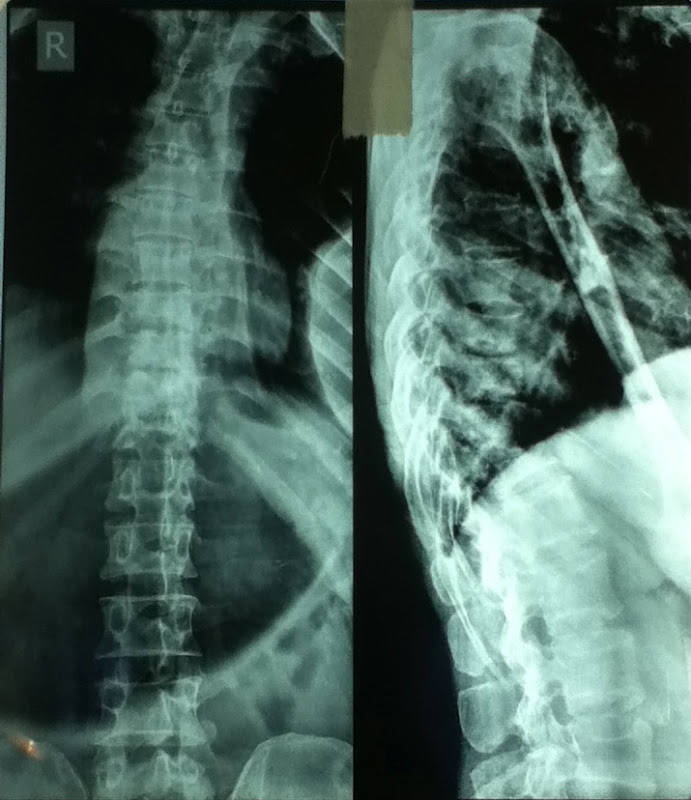
There were several interesting cases (interesting in the sense that it is something I would not see at home - often being labeled as “interesting” is not a good thing for the patient) that came into the ortho clinic this week. One was a young boy who had a fracture of his humerus that should have been treated with surgery but was not because the family was poor and could not afford the surgery. According to my attending, this boy developed a bad infection (osteomyelitis) of his humerus because of the fact that he was not treated appropriately. I saw a few patients with tuberculosis of the spine and one with tuberculosis of the peritoneum. A woman came with osteomalacia due to severe Vitamin D deficiency that was caused by her religious dietary restrictions. Sometimes vitamin and mineral deficiencies are due to poverty, but there are a larger number that are due to strict religious dietary restrictions from both the Hindu and Muslim religions. 

TB abscess seen on xray
The ortho wards also continued to be very busy with our team rounds (I think there are 3 teams total - so we only see a fraction of the entire ortho service at the hospital) consisting of 30-40 patients. Like in clinic, on the wards I saw several patients who had delays in treatment or no treatment at all due to their lack in ability to pay for the surgery that they needed. Patients are required to pay for their surgery in full before they have it even if a delay in the surgery would likely worsen the outcome for the patient in terms of post-op morbidity. There were at least two cases that were nearly cancelled the day of surgery because the patients had not paid for the entire surgery. One was a patient with a femoral neck fracture and the other was a patient with severe TB of the spine resulting in paraplegia. Before the TB patient was able to pay for the entire operation that was scheduled, the surgeon contemplated only doing the part of the surgery that the patient could pay for - he needed a spinal decompression with implants placed to support his spine were his bone had degenerated due to the TB. The surgeon considered only doing the decompression with an anterior rib graft placed and skipping the posterior implants which could have resulted in significant morbidity for this patient. Thankfully, the patient was able to round up enough money to pay for the entire surgery which would give him the best chance at recovery with the least loss of function.

tuberculosis pus from abscess
On our operating days, I did not stay for 11 hours like I did the previous week. There were fewer cases on the schedule so I got done much earlier.  There were two really interesting cases. One was a patient that I had seen twice in clinic - a boy who was a victim of a snake bite that became infected and gangrenous which resulted in the boy having part of his foot amputated. The amputation resulted in a deformity of his foot that was causing him pressure ulcers since he was putting his weight over uncushioned bone. I observed the surgery for the correction of this deformity - a wedge of his bone was taken out and what was left of his foot was brought forward so that the new weight-bearing part of his foot would be the calcaneal heel pad. This boy also came from a poor family and so instead of having screws placed to fix his foot in position, he only had k-wires to hold the correction. He won’t be able to bear weight as quickly because the fixation is not as strong. Hopefully, it will heel well and the boy will be able to have a relatively normal life. The second really interesting case was the TB spine patient. I didn’t stay for the entire case mostly because I couldn’t see - there were 4 people scrubbed in so I couldn’t see at all - but also because it made me nervous to be in the surgery. The patient had a really large TB abscess next to his spine which was opened during the surgery and we were all only wearing regular surgical masks, not the special masks that we wear in the US with any patient with even suspected TB. The one TB surgical case I saw in the US, we basically worse space suits for the surgery that had their own air supply so we wouldn’t breathe in any potentially aerosolized particles of TB. Of all of us in the OR, I seemed to be the only one really uncomfortable with breathing in the presence of an open TB granuloma...

Julia, me, Kim @ Love Shack
In terms of my social life, it continues to be pretty happening with the German medical students. One evening I had dinner at Little Italy - yes, Italian food in India. The food is nothing special, but when you are craving something not Indian, nothing special tastes pretty amazing.  We went to this newly opened Beer Garden that brews their own beer. Not as good as WI and MN beer, but still pretty decent. Unfortunately, I couldn’t really enjoy my beer because over the course of a couple of hours, I developed a fever (101.5 F) and felt pretty miserable. I have no idea what the cause of it was. The next morning, I felt better but since I wasn’t sure what was wrong, I stayed home from the hospital and took it easy. And believe me, a day of rest in the Annex 1 is not all that restful nor is it preferable to being at the hospital because at least at the hospital there aren’t cockroaches (at least none that I have seen). After I felt better, I went to a Bollywood movie with Julia and Michael which was one of the most entertaining experiences I have had so far in India. The movie was in Hindi so I didn’t understand a word of the dialogue, but the plot was pretty simple to follow and we all felt like we had a good understanding of the movie without knowing what was being said. The biggest problem was that none of us knew what the names of any of the characters were except for the main character so when we talked about it afterwards, it was all based on description. Bollywood movies are quite long - typically 3-4 hours and they include an intermission. They also have several big musical numbers with dancing which is also quite fun to watch. The audience gets really into the movie and will often cheer when the hero appears. They also aren’t so good about turning off cell phones - the guy sitting behind us answered his phone twice during the movie... Probably the funniest part of the movie was when one of the characters lit up a cigarette and the only line in English flashed across the bottom of the screen: “Smoking is harmful to your health.” I think Julia, Michael, and I were the only ones that were laughing at that. Wednesday evening I went to a bar called the Love Shack with Kim, Julia, and two of our Indian friends - Mahesh and Prash. It was karaoke night and Mahesh, Prash, Julia, and I sang Wonderwall. It was a fun night but a late one. Although bar close is 11:30 which would have been a decent time to go home and get some sleep before going to the hospital the next day, we ended up at an after party which really wasn’t all that much fun. I was getting really tired and was very glad to get back to the Annex to get some short sleep in.  Thursday, I was tired from the busy social life week I had been living and didn’t feel like going anywhere beyond walking distance. I had dinner that night with my German friends (Kim, Carina, and Michael) and my American friend Jonah at our favorite close-by Indian restaurant Sukh Sagar. Friday was the last day on the ortho service and I finished relatively early - enough time to pack up my stuff for my upcoming weekend trip with my German friends to Ooty. Namaste.
bucket shower
cockroach roommate (a small one...)

Sunday, January 29, 2012

Hampi


During my first week of rotations at St. John’s, I met a group of American and American/Israeli medical students that are at St. John’s for 6 weeks of an elective course. The 5 of them are all doing the same rotations but two are from Columbia in New York and the other 3 are Americans that are going to medical school in Israel that associated with Columbia. Since most of the Germans were going away for a long weekend, I decided to join 4 of the Americans in a weekend trip to Hampi. I definitely felt the need to get out of town after moving into the Annex 1 (see previous blog). Hampi was once the site of a large Hindu empire in India. It is thought of as the home of the monkey Gods. It is a city of ruins from the temples and height of the Hindu empire that once ruled in the area. It is also a nice break from the big city life of Bangalore as the city of Hampi lies along a river and the scenery is a mix of rice paddies and giant boulder hills. 

The American students arranged the transportation and the lodging which was very nice for me since I was able to just join in without having to do much of the planning. After traveling for a while on my own, this is a welcome break. We were picked up from the Annex 3 at 12am Friday night/Saturday morning by a hired driver. We rode semi-comfortably in a Toyota SUV for 7+ hours to Hampi. Unfortunately for me, I ended up in the front co-pilot seat which meant that at every toll stop (which seemed to occur about ever one hour), I was woken up by the driver to pay the toll. Of course this meant that by the time we arrived in Hampi, I was not feeling very rested. We made our way to our accommodation - Shanthi Guest House - dropped off our bags and cleaned up before heading out to start seeing the sights. We only had 1.5 days to see Hampi which from what I had heard from the Germans is not nearly enough time as the pace of Hampi is very relaxed and once you get there, you don’t really feel in a rush to leave.

On the recommendation of the German students, I suggested we rent bicycles to bike around the rice paddies and see some of the temples on the other side of the river from Hampi Bazaar and the same side where our guest house was. I was overruled by the other American students who really wanted to rent mopeds (even though they were much more expensive and didn’t include a helmet and to me felt much more dangerous to ride around on the rule-less streets of India). I closed my eyes, took a deep breath and sent out positive thoughts for my safety. I didn’t ride my own since I had never driven one before, I didn’t feel comfortable driving one myself. In retrospect, I’m not sure if that was the best idea although I did make it through the day in one piece and we only fell over one time - a very low speed fall to the side which helped us to learn early on that I needed to get off the bike when we were turning around. 

It was a beautiful day and was incredibly peaceful riding through the rice paddies and the boulder hills. I would have preferred being on a bike not only for my own safety, but also because bicycles seemed to fit the atmosphere of Hampi much more than a moped. I guess this is what happens when you travel with a group - I don’t have the same independence as when traveling alone and when people differ on what they want to do, someone ends up not getting to do the things they want. I still had a great time and really enjoyed Hampi, so I can’t complain although if I had to do it again, I would go about it differently.

We visited a few different Hindu temples recommended by the Lonely Planet although several of the temples have similar names and the maps are not all that great so we ended up going to one temple that we discovered later was not the recommended temple to visit - this was the first temple we visited which I did not find all that impressive. The best part of the first temple were the children that were wandering around the temple grounds. They were dressed up in very colorful clothes and were quite friendly and wanted to take pictures with us which is always a joy.

The second temple we visited was really cool not because of the temple itself (after a while, a lot of them start to look the same...) but because of the landscape it was situated on. After walking past the temple, there was a small canal/well that provided a great photo opportunity. When we walked a bit further, we ended up in these cave-like structures created by the piles of boulders. Inside was much cooler than standing outside in the sun and was a refreshing break. Continuing through the caves, we could climb up a sort of rock scramble stair case to the top of the boulder hill and had a great view overlooking the landscape of Hampi. From here, we could see the river, the rice paddy fields, and the monkey temple which was on a higher boulder hill and from where we planned to see the sunset.

We left this temple and had lunch at an Indian restaurant that served only one thing - the South Indian Thali. We each got a metal plate with a palm leaf on it and had several different gravies (curries), breads, and rice piled on. It was delicious. After lunch we made our way on the mopeds to a reservoir lake that one of the girls had heard about from a rickshaw driver she started talking to when we got into Hampi that morning. It took a while for us to find the reservoir but we did find it and a large group of people from all over Europe that were swimming and cliff jumping off the boulders into the lake. Hot, sweaty, and dusty from the night of traveling and the day riding around on the mopeds, getting in the lake sounded heavenly. Of the 5 of us, 4 of us joined in the cliff jumping and were rewarded with being submerged in cool water.

Refreshed after our brief swim, we took the mopeds to the monkey temple. To reach the top of the monkey temple requires a climb of about 570 stairs. It was a long way to the top but on the way, I had a gorgeous view of the surrounding countryside and was entertained by several monkeys playing on my walk up. It was nice to sit and relax at the top while waiting for the sun to set - relaxing until a snake crawled out from between two of the boulders and slithered right in front of my feet. In my state of fear, I somehow remembered that with a snake, you should stay very still which I somehow managed to do and the snake slid away. Thankfully the sun set soon afterwards and we made our way back down the 570 stairs to the mopeds and back to our hotel. 

Our hotel was a collection of individual huts that to my great satisfaction had 24hrs hot water. I took a much desired hot shower and after we all felt clean again, we had dinner at the hotel restaurant. Exhausted after our day, we all went to sleep early.

Hanuman (monkey) Temple
Sunday morning we got up fairly early to check out, drop our bags off with our driver, and see the sites on the other side of the river before heading back to Bangalore. We took the ferry across the river and dropped off our bags. We then hired a couple of rickshaw drivers for a half-day tour of Hampi. We started out at the Royal Centre of the city where the ruins of the Hindu royalty as well as a giant elephant stable were located. After visiting the Royal Centre, we made our way to the Queen’s bathtub which is more like a swimming pool in size. I can imagine that if I were the queen, I would not leave my bathtub. Our final tour stop was at the Vittala Temple which is the main highlight of the Hampi tour. It is a very well preserved Hindu temple that reminded me a lot of the new 2005 temple built in Delhi. I liked this one better just because it was older. It was just as exquisite with the entire temple carved with spectacular Hindu figures. There was also a large stone chariot in the center of the temple that at one time actually carted people around.

view from Hanuman Temple
Satisfied with our tour, we went to the Mango Tree Cafe for lunch. It was a fantastic cafe with an incredible view and even better food. We enjoyed our meals slowly before boarding the SUV for the ride back to Bangalore. I again sat in the front seat on the way back but thankfully we arrived in Bangalore in time for me to get an adequate (well, as good as it can be in the Annex 1) night’s sleep before starting my second week of orthopedics. Namaste.


AM Ferry Crossing

elephant stable

queen's bathtub

Vittala Temple

Vittala Temple

Friday, January 27, 2012

"This is not kindergarten."


Banana Beach Bar

I have to say that although things move quite slowly here in India, the time is going by rather quickly. I have already been in Bangalore for nearly 2 weeks at this point and have done a terrible job keeping up with my blogging. I spend the day in the hospital on my elective rotations then go back to my room and usually eat something and do some of my laundry via handwashing. I discovered that handwashing clothes takes a long time (maybe it’s because I am never quite sure how to tell when they are clean...) and the best way to approach laundry here is to do a little each day and hang it out on the line to dry. Since we do not have a kitchen in our housing accommodation, I go out to eat a lot. It’s pretty cheap to eat out depending on where you go, but I usually spend about $2 or less per meal. The main problem I have with going out to eat deals with my first statement - things move quite slowly here in India, including the food service. It is not unusual for a meal out to take a full 2 hours starting from the time we start walking there to the time we get back to the Annex. I do have some snacks in my room for when I just really don’t feel like going out. Walking around is always an experience as there don’t seem to be any traffic rules and as a pedestrian, I really feel that I have no right-of-way even if the traffic signals say I do. The sidewalks are in pretty lousy condition as well. As a result of all this, by the time I get back from dinner, it is time to shower and get ready for bed. 

Life in Bangalore:
There are a lot of places to eat around Bangalore. The city is home to about 8 million people and as a result is rather large and crowded. There are several good restaurants within walking distance from the hospital and these are the places I typically eat. Sukh Sagar is a favorite of mine and of the German medical students that I have gotten to know since arriving in Bangalore. Monday night, two of the German students wanted to go eat at a place called Food Street. I don’t know if that is the actual name of the street, but it is a place known for it’s street food. Vendors come out in the evening with a wide range of Indian cuisine made fresh before you for you to enjoy. It’s a great place to go with friends because we are able to sample several different things. This was definitely my favorite food experience in India so far.

mango corn at Food Street
I have been very thankful for my new German friends and have benefitted greatly from their knowledge of Bangalore since most of them have been here since the beginning of December. They always have places to try and are so inclusive. The downside to that is that I wind up spending a lot of my evenings out and don’t get back very early to get some reading or blogging done before I have to get ready for bed. The upside (and the upside definitely wins) is that I am making some great friends and getting to experience more of Bangalore than I think I would have on my own. Some of the other places I have enjoyed going out to with them include the Banana Beach Club (a really cool bar with a beach theme and some of the tables are actually little islands that you have to step across water in order to sit at them), The Egg Factory (known for it’s European/American menu - sometimes you just really need a taste of home), and the Chocolate Room (yes, a restaurant devoted to all things chocolate). 

Another great thing besides the friendship and the food experiences that I have had with my German friends is that they included me in their plans when we were kicked out of the Annex 3 on January 27 due to the arrival of a lot of Catholic bishops who were very clearly more important then the foreign elective medical students. The alternative accommodation offered to us was truly unacceptable - a hospital about 20km away (which would probably take 1 hr by car or 2 hrs by bus each way just because of the traffic) that really didn’t have much surrounding it. We would have seriously been stuck. The Germans were instead able to arrange for us to stay at the Annex 1 which is another lodging on the St. John’s hospital grounds. We have to share rooms, but at least we don’t have to commute 2-4 hrs per day to get to the hospital. 

general hospital ward room
The Annex 1. There really is not much good to say about the place. It’s on the hospital campus and right across from the hospital canteen. My internet works better here than at the Annex 3. And that’s about all it has going for it. My room is equipped with an Indian toilet: a porcelain-lined hole in the floor that you have to squat over. For those of us not used to toilets like this, it is uncomfortable and difficult to use. For me with my broken hip and limited hip abduction and flexion abilities, it is a real challenge. All I can say is that I don’t think I have ever spent so much time washing my feet :( Continuing with the bathroom - there is no shower and no hot water. I fill a bucket with cold (not freezing, but cold) water and take a bucket shower every morning. At least it wakes me up I guess. Now those things are uncomfortable, but manageable. Even the rock hard mattress would be tolerable in addition to the bathroom issues. Even the fact that the walls are paper thin and I hear everything out in the hallway which for some reason seems to be a popular hang out around 5 in the morning could be tolerable. The thing that really puts the Annex 1 as the worst place I have ever lived in my entire life is the cockroaches. Disgusting, scurrying cockroaches. Also, the room just does not seem to be all that clean. I am counting down the days until I can leave. I fully plan to harass the Annex 3 as soon as the bishops leave on February 10 to get my room back in place that is at least clean and has the bonus of a hot shower, a relatively soft bed, and a normal toilet. Thank goodness I have plans to be gone for a few weekends of the Annex 1 experience which cuts down on the time I actually have to spend here. 

The Hospital:
As I mentioned in my previous blog, I am spending the first two weeks of my elective time at St. John’s in the orthopedics department. Medical students in India are apparently not allowed to touch patients so my experience as a student is limited mainly to observation. This was also my experience for the most part in Sweden as well. The nice thing about observing in India is that there is a lot to see. Everyday I encounter patients and cases that are things unique to the tropics and to the developing world. It is a fascinating learning experience. I also look at it this way - India is preparing me with theoretical learning about medicine in the tropics and in the developing world so that when I arrive in Kampala, Uganda in April, I will be ready to apply this knowledge in practice since I believe my experience will be much more hands-on there.

The orthopedics department is a very busy place. Our morning rounding list in the hospital is between 35 and 40 patients. In clinic, we see 40+ patients in a half-day. Even though an orthopedic surgery residency in India is a short 3 years, those 3 years are packed with experience. Residents (at least interns) only get 1 day off per month. In the morning, the resident/intern will present the patients that were admitted to the service the night before. Even if they had spent the night on call, they are expected to know everything about the patient, the patient’s problem, and the theoretical knowledge behind the approach to that problem. I have never seen such intense pimping in my life. When the resident/intern didn’t know the answer, the staff would tell him to write down the questions and read up on it later to find the answer. At one point after several questions to which the intern did not know the answer, one of the staff started to tell him the answer. He was stopped by a more senior staff member who said, “This is not kindergarten. He needs to learn it for himself.” Yikes! 

OR scrub sink
It’s always interesting to see how a hospital is run in another country. I can’t generalize and say that how it is at St. John’s is representative of all of India, but it at least gives me an idea of the hospital system in place here. I’m not sure if this is because it is a Catholic hospital, but the nurses are all referred to as “Sister.” I don’t think I have once heard a doctor use a nurse’s actual name - they are all just “sister.” I also haven’t seen any male nurses, but the male staff in the OR are sometimes referred to by “brother” and sometimes referred to by name. In this system, you do not need to have a referral to see a specialist. Any patient can see any type of doctor they want and at least at St. John’s, most of them don’t have appointments beforehand. The hospital has limited resources. I don’t think this is the case for all hospitals but St. John’s serves a poorer population because it is a Catholic mission hospital. For the prevention of pressure ulcers, they use gloves filled with water and place them under the patient’s heels. The beds in the general wards are not adjustable hospital beds, so in order to elevate the foot or the head of the bed, concrete blocks are placed underneath the bed legs. It works. I have seen a lot of family members staying with patients and if they are not rich enough to afford a private room that has a bed for family, the family member will lay a mat on the floor beneath the patient’s bed and sleep on that. In the OR, they use a lot of reusable items. The scrub gowns are cloth as are the drapes and I noticed that some of them have holes. There seem to be a lot of people that wander in and out of the OR - mostly OR staff. They tend to sit in a room off to the side of the OR and chit-chat while the surgery is going on. It kind of reminded me of Haiti when the interpreters would all congregate in a clinic room and socialize even if a patient was in the room. This sometimes meant that they weren’t doing their job which is also the case here at times.

hospital bed with the foot elevated
I have seen a lot of interesting cases during my time on the orthopedic service so far. There is a lot of trauma at the hospital which is similar to the trauma seen at home. Tuberculosis is very prevalent here and there are a lot of patient’s with TB infecting nearly any part of the body. Thankfully, only the pulmonary TB is ultra contagious and I have yet to see a case of that. I have seen patient’s with TB of the spine, abdomen, hip, and lymph nodes. I have seen a couple of patients who suffered fat embolisms after long bone fractures because they were not treated promptly after their injury. In peds clinic, I saw two children with radial club hand - a congenital deformity which has increased incidence in consanguineous marriages resulting in the absence of the radius. The forearm tends to be short because the ulna bows and the hand is deviated towards the pinky. The thumb is also hypoplastic and basically non-functional. The surgical correction sounds pretty cool - the first procedure is an ulnar centralization where the ulna is moved to the center of the forearm to help straighten out the arm. Then in a second procedure, the index finger is rotated so that it can function as a thumb so the child will be able to grasp objects and write. Although the hospital is able to help kids like this, there are an unfortunate number of patients with orthopedic problems that do not get to a hospital early on and a result have a huge morbidity from their injuries. There are a lot of neglected cases that end up with the patient having some permanent disability because they were not able to receive proper care early on. Although I wish I could participate more in the care of patients, I have been really interested in the things I have seen and have been really motivated for independent study. I think this will be a valuable learning experience medically and personally and after my first week, despite some of the challenges, I am glad to be spending time in this incredible place. Namaste.

Monday, January 23, 2012

1st Official Day - Orthopedics at St. John's Medical College


This week I started my elective training at St. John’s Medical College in Bangalore, India. I have decided to start with two weeks of orthopaedics. The morning started out with breakfast at the hospital canteen with Julia and Sandhya. For 30 rupees (about $0.60) I had tea and toast for breakfast. (I ate a banana before heading to breakfast for some fruit). The other German students joined us at the canteen and we walked to the Annex I where we are hoping to relocate during the two weeks we are kicked out of the Annex III due to the Bishop’s conference. As expected, it took way longer than it should have and was this complicated process to view the rooms then arrange for our two week stay. It seems like everything is set for us though and Friday I will be moving to the Annex I. It’s not as nice as the Annex III and we will most likely be sharing rooms and I am not sure if there is hot water. But at least we are on the hospital campus. And it’s only for two weeks. If it’s really miserable, I’ll be sure to take a weekend trip between the two weeks for a break!

clinic exam bed
I was worried that I would be late for my rotation. I got the orthopaedics office shortly after 9:30 and was told to go to the outpatient department (OPD) to meet with the head of the department and observe him for the day. When I arrived at the OPD, there were tons of waiting patients but no doctor. I asked if this was the place and was told to wait - he would arrive shortly. About an hour later, the ortho surgeon I was to observe arrived as well as one of the senior residents (ortho residency here is only 3 years after 5.5 years of medical school which is started immediately following high school). Clinic was completely crazy. Both the staff and the resident were seeing patients in the same room and I sat in a chair between them so I could observe both and get a sense of every patient. The two doctors were sharing a desk and there was no divider between the patients that each one was seeing. Privacy seems to not really exist here. Things were moving at a quick pace and I asked questions when I could get them in but mostly I just took it all in. We stopped for a coffee break about an hour and a half into the clinic. I finally got a chance to talk some with the staff doctor and tell him a little about myself and what I was hoping to get out of my time on the rotation. I said that I was hoping to get a sense of medical practice in India and see a wider range of pathology than I am exposed to in the US. I also said that I was hoping to improve my clinical skills. Both the staff and the resident were really helpful in showing me different exam techniques they used when evaluating orthopaedic patients. The clinic ended about 1:45 after seeing 41 patients. It really reminded me of the craziness of doing ortho clinic in Haiti...

Very few patients have an appointment – only 4 of the 41 patients seen today were scheduled. The rest of the patients walk in in the morning and are given a number in the queue then wait until their turn to be seen. The patients bring their own records to the clinic. 

clinic room
I was not disappointed in what I observed in clinic. There was the usual bread and butter ortho - back pain and arthritis - but also the unusual stuff that comes in the tropics and an unfortunate number of neglected cases that were not treated properly at the start due to lack of access and poverty. Tuberculosis is a big problem in India and is in the forefront of the differential for many clinical presentations. We had one patient today with TB of the spine. The other really interesting patient today was a boy who had been bitten by a snake and wound up with necrotizing fasciitis. He then had a mid-tarsal amputation of his foot to get rid of the infection. Now he has developed an equinous deformity due to unopposed plantar flexion from the achilles and is getting a pressure ulcer at the stump site. The staff surgeon is planning on correcting his deformity by removing one of the bones in his feet to bring the calcaneus and the calcaneus heel pad forward so that the weight of his body concentrates on that heel pad.

Speaking of interesting patients, I forgot to mention one other patient I met last Friday at the outreach clinic. It was a patient with Wilson’s disease which I have not seen before in the US. He had the classic Kayser-Fleischer rings in his eyes and a dystonia due to the copper deposits in his cerebellum. Great clinical findings to be able to make a diagnosis and treat him!

At the end of clinic, the staff invited me to the resident’s seminar at 2:30. Residents are responsible for giving lectures and are horribly pimped during their presentations in a very harsh way. The presentations are picked apart by the head of the department. I felt so sorry for the presenting resident. He seemed so nervous before the presentation started and was stopped on most every slide and asked a range of questions that he was expected to know the answers to, even the really obscure questions. At the end of the presentation, the head of the department told him what he should have also included and how he should approach his next presentation. His final conclusion - “It could have been better.” OUCH!

I came back to my room after the lecture and did some more handwashing of my clothes. I plan on reading up on TB tonight and am looking forward to a new day at the hospital tomorrow. Namaste.

Sunday, January 22, 2012

It's All Part of the Experience...


First off, it is a complete nightmare to try and get connected in India. I have never had to jump through so many hoops or be so persistent to get something done in my life. Things here seem to run on phones so having an Indian phone number was a must especially since I am going to be here for a couple of months. Also, in order to get internet (which is most easily done with a 3G USB stick), you have to have a verifiable Indian phone number. Even to use WiFi in a cafe/coffee shop (which there aren’t many that have WiFi available), you have to have a verifiable Indian phone number. To have an Indian phone number, you have to buy a SIM card. In order to get a SIM card, you must have a passport size photo, a copy of your passport and visa, and a proof of address. On Friday morning, I met with the foreign student coordinator to fill out some paperwork, discuss my postings at the hospital, and to get a proof of address letter. My frustrations started early in the day on Friday. First of all, I sent in a payment to the school to do elective training here. When I arrived, Patima informed me that I still owed money to the school. Apparently because I sent in a cashier’s check in USD, some conversion fee was extracted to change it to rupees. So my $620 check to the school was only worth about $520 and I had to pay another $100. Of course no one tells you these things in advance. I feel like money is leeching out from me on a regular basis which just adds to the constant feeling of being drained that I have had since I arrived in India. After I paid my fee and gave her a passport size photo to put on my ID badge, I was brought to Dr. Sanjiv who is the physician in charge of the international students. He was in the middle of clinic but it didn’t seem to matter to be interrupting his patients for me to talk with him. Privacy doesn’t seem to really exist here in India. As we were discussing my electives, patients were brought into the clinic room to sit and wait until we were done with the discussion. The nice thing about electives at St. John’s is that they are very flexible. I can do pretty much whatever I want for however long I want. If I start a posting and don’t like it, I can switch after a week to something new. I told him that I was interested in doing emergency medicine, orthopaedics, ob/gyn, community health, and pediatrics. As soon as I mentioned orthopaedics, Dr. Sanjiv got all excited and asked what I was doing the rest of the day. Apparently there was a specialist outreach clinic that was traveling to a nearby village to provide a peds ortho clinic. He called the pediatrician on the team and got me a spot in the van to head to the village. 

Julia and me
It was a really great experience to spend part of the day at this village hospital. I saw several things that day in clinic that I have never seen before in my few years of clinical experience and things that I am not likely to see in the US. The first patient of the day was a child with (very obvious) rickets. Vitamin deficiencies are a major problem especially for poor people in India. I then met a child with dystonic type cerebral palsy that has affected his arms more than his legs. The child had taught himself to use his feet as hands and showed me how he could unwrap and eat candy and write with his feet. I then saw an adult with an amputated arm. This guy had been in a farm accident a few years ago and broke his arm. He didn’t have access to a hospital or medical facility so the local “medical” expert had him wrap his arm very tightly in bandages. This led to ischemia of his arm which then necrosed and became gangrenous. As a result, the patient had to have his arm amputated. A simple fracture that because of a lack of access resulted in the patient losing his dominant arm. I saw a child with isolated growth hormone deficiency - 12 years old and less than 3 feet tall. I saw an 11 month old baby with vitamin B12 deficiency (mother was breastfeeding but was B12 deficient due to being a lifelong vegetarian). And finally I saw a woman in her mid-30s with a post-polio residual palsy. Mid-30s and had polio. It was a great day for learning and seeing some really interesting medicine and on the drive back to St. John’s, the frustrations seemed to take a backseat to my excitement for this incredible learning opportunity.

Sandhya and me
After arriving back at the hospital, I went to Patima’s office to finish up my paperwork. She gave me my name badge and my posting letter for ortho to start on Monday. My proof of address letter still needed to be signed so she asked me to stop by Saturday morning to pick it up. I walked back to the Annex III and ran into a couple of the German students that I had met the night before. They were going out shopping and then to have dinner with the rest of the German students and a Nigerian student that was leaving on Saturday. They invited me to join them. I spent the rest of the afternoon with my new friends Julia and Sandhya who showed me around the neighborhood, where I needed to go to get a phone and internet, and had a blast! We ate dinner at a restaurant nearby the hospital and I met the other students. It was a great evening that ended with making plans for Saturday: lunch, more shopping, and an evening out at one of the clubs in Bangalore.

my room in the Annex
Saturday morning I went to Patima’s office to get my letter. When I walked in, she told me that it wasn’t ready and that I could pick it up on Monday. I told her that it takes a few days to get a working phone once you submit your application for the SIM card and I really couldn’t wait until Monday to get the process started because everything in India seems to require a working phone. She then checked at the dean’s office and...surprise, surprise...the letter was signed. She had not checked prior to my arrival that morning as she had claimed. I have learned that I need to be insistent and persistent bordering on rude in order to get things done. I took my letter and walked to the Airtel store that Julia had said to go to to get a SIM card. I was anticipating the worst at the phone place and was pleasantly surprised. The woman who helped me filled out my application for me to be sure that it was filled out correctly. She asked me for the names and numbers of (Indian) friends in Bangalore. I told her I had just arrived and didn’t know anyone. She said she just needed one name and one phone number. I pulled out my piece of paper with Dr. Sanjiv’s phone number written on it and wrote his name and number down. I also found my piece of paper with the guy I met on Thursday who bought my coffee and wrote down his name and number. She told me my SIM would likely be working by Saturday evening. I bought a simple Nokia phone and had the SIM card inserted and crossed my fingers that my application would be approved.

I walked back to the hospital and met Julia, Sandhya, and another German student Ruby for lunch at the hospital canteen. We then left for shopping on Commercial Street. Getting a rickshaw to take us to Commercial St. was a process. Some of the drivers didn’t want to go and others refused to use the meter. After about 10-15 minutes of failed attempts to find a rickshaw that would use the  meter (which they are required by law to use), we finally got one and made it to Commercial St. It is a busy shopping area with a combination of western and Indian stores as well as roadside stalls for market bazaar type shopping. Like everywhere in India, it was crowded with people, cars, and dust. Every store we walked into, we were immediately accosted by salespeople who stand uncomfortably close to you and try to help you shop even when you politely decline their help. There is great shopping in India but it really is an exhausting experience. Needing some comfort, we went to McDonald’s for lunch. I never eat at McDonald’s at home, but after being surrounded by the unfamiliar, I needed something familiar. I treated myself to fries and a Fanta orange float. While we were out shopping, I received a text message informing me that my application was approved and my phone was now working! We stopped for coffee at a Cafe Coffee Day and I was excited to try out my phone. I asked for an internet login after ordering (the sign on the door said free WiFi) and was told that they didn’t have WiFi. I started arguing - I mentioned that the sign on the door said there was WiFi. I was then told that I would have to pay 27 rupees for an access card to use the WiFi. I argued again stating that the sign said the WiFi was free. Not getting anywhere, I told the coffee shop worker to forget it. For every good experience, I have at least 3 frustrating ones...

After shopping, we headed back to the Annex III with the same frustrating arguing to find a rickshaw to bring us back to the hospital. We had about an hour before we needed to head out to meet up with Julia and Sandhya’s friends at the club.  

handwashing clothes :-/
The club we went to was a sports bar and there were soccer matches playing on every tv. The really nice thing about the bar is that they actually had free WiFi - WiFi that you didn’t need a password or a verifiable Indian phone number for! I did what I hate seeing other people do and immersed myself in my iPod - I checked emails, started sending IMs to people through messages. It’s amazing how dependent I have become on the internet for being connected. It makes it so much easier and I just feel closer to my friends and family when I am connected to the internet. After a while, I stopped being rude and enjoyed the company of my new friends. We had a great night. Bar close in Bangalore is 11:30pm which meant we got back to the Annex at a reasonable time and could get a good night of sleep.

This morning (Sunday), I decided to tackle getting my internet. I walked to the store in the Forum Mall that Julia told me to go to for getting the 3G internet stick. I was a little worried because I had foolishly given my only copy of my proof of address letter to Airtel the day before for my phone. Airtel was closed on Sundays so I was unable to get the letter back from them. Julia had not needed her letter in order to get the internet, so I was hoping that it would be the same for me. For 1000 rupees ($20), I could get the TaTa DoComo internet. At first I was told that I didn’t need the letter - that my passport copy, photo, and verifiable phone were enough. Then I was told that I needed the letter and would not be able to get the internet stick. I explained that I gave my letter to Airtel and that they were closed on Sundays so I could not get the letter back from them. I also explained that the person I needed to get another letter from at the hospital was not working on Sunday so I probably could not get another letter until Tuesday. I asked if there was any way around it. The sales clerk told me that if I got the Airtel 3G stick and paid 1500 rupees, I would not need the letter. Fine. More leeching of money. But it is oh so worth it to be connected to the internet in the comfort of my room! 

Final note for any of you traveling to India. When you go out to eat, you have to look at the menu because oftentimes large parts of the menu are unavailable at certain times of the day. Tonight Julia, Sandhya, and I went to eat at 5:30. Over half the menu was not available between 3:30 and 7. Also, it is not infrequent to go to a restaurant and try to order something only to be told that they are out. As Sandhya likes to say, it’s all part of the experience... Namaste.